| Title: | Fracta Language Specification for Fractals |
| Author: | Vincenzo Manto |
| Date: | |
| Link: | https://github.com/VincenzoManto/Fracta |
| Keywords: | mathFractalsDSL |
| DOI: | https://doi.org/10.5281/zenodo.21755350 |
Fracta Language Specification for Fractals
This document defines the formal grammar, lexical structure, and runtime execution semantics of Fracta v1.0, a minimalistic, line-oriented domain-specific language (DSL) designed for the generation of recursive geometric topologies. Fracta maps string-rewriting Lindenmayer Systems (L-Systems) directly into deterministic vector trajectories via a stack-based turtle graphics state machine. The language optimizes syntactic overhead to achieve low cognitive friction and high parse efficiency in resource-constrained or distributed environments.
Status of This Memo
This specification documents the stable core syntax of Fracta version 1.0. Conforming interpreters and compilers MUST implement the complete lexical validation rules and execution state machine outlined herein to ensure platform-agnostic output consistency.
Table of Contents
- Introduction and Architectural Intent
- Lexical Structure & Tokenization
- Core Directives & Structural Syntax
- Turtle Graphics Alphabet & Execution Semantics
- Formal Grammar (EBNF)
- Reference Syntax Blueprint
- Runtime State Machine & Memory Layout
- Results
1. Introduction and Architectural Intent
Lindenmayer Systems provide a powerful mathematical framework for modeling plant growth, cellular structures, and space-filling recursive curves. However, implementing these systems programmatically often requires custom data structures or verbose configuration scripts that scale poorly under line-oriented serialization frameworks.
The Fracta language standard bridges this gap by providing an ultra-lean, plaintext tokenization layout. Fracta isolates the genetic elements of a fractal (the axiom and the production rules) and exposes them through a deterministic, instruction-driven syntax block. By standardizing string manipulation and mapping it to structural coordinates, Fracta serves as a predictable intermediate representation for rendering engines, plotting hardware, and algebraic compilers.
2. Lexical Structure & Tokenization
Fracta scripts are evaluated sequentially as a stream of line-buffered string arrays. Interpreters MUST adhere to the following parsing rules:
- Case Sensitivity: Structural directives (
AXIOM,RULE,ANGLE,ITER) MUST be declared in uppercase. Variable parameters within rewrite strings are case-sensitive. - Line-Oriented Boundaries: Each line in a Fracta payload represents a single, distinct compiler instruction. Arbitrary line breaks within a single directive boundary are prohibited.
- Whitespace Treatment: Leading and trailing horizontal whitespaces (ASCII 0x20, 0x09) MUST be stripped prior to execution analysis. Multiple contiguous spaces within rule transformations are compressed or treated as delimiter padding.
- Comment Truncation: Any line initiating with the hash character
#(ASCII 0x23) or any inline string following a#sequence MUST be discarded by the lexical scanner as non-operational commentary space.
3. Core Directives & Structural Syntax
A valid Fracta program configures the string-rewriting engine using four foundational directives before executing a build pipeline.
3.1. AXIOM
Defines the initial seed string (the structural foundation) at recursion iteration zero ().
- Syntax:
AXIOM <string> - Constraints: MUST contain at least one valid character symbol.
3.2. RULE
Declares an production transformation rule mapping a single character predecessor to a replacement string successor.
- Syntax:
RULE <predecessor> -> <successor> - Constraints: The predecessor MUST be a single ASCII alphanumeric or symbolic character. The transformation delimiter
->MUST be present.
3.3. ANGLE
Specifies the absolute angular offset step in degrees applied during turtle rotational operations.
- Syntax:
ANGLE <float> - Behavior: When a rotation token is encountered in the compiled string, the internal heading matrix is re-computed using this step size.
3.4. ITER
Controls the total evaluation recursion depth ().
- Syntax:
ITER <integer> - Constraints: Must be a non-negative integer. An iteration of
0returns the un-mutated Axiom string.
4. Turtle Graphics Alphabet & Execution Semantics
Once the rewrite pipeline processes the strings to the depth specified by ITER, the resulting character chain is parsed as sequential commands for a spatial vector tracker (the “Turtle”). Compliant interpreters MUST map the following tokens to their exact physical sub-routines:
| Token | Operational Command | Execution State Modification |
|---|---|---|
F | Move Forward (Draw) | Advances the linear position coordinate from to drawing a structural line vector. |
G | Move Forward (Draw) | Synonymous with F. Used primarily to handle dual-variable simultaneous substitutions. |
f | Move Forward (Pen Up) | Advances the position coordinate to without writing data to the rendering matrix. |
+ | Rotate Right | Modifies the heading angle: |
- | Rotate Left | Modifies the heading angle: |
[ | Push State | Saves current position and heading onto the LIFO tracking stack. |
] | Pop State | Restores position and heading from the apex of the LIFO tracking stack. |
All non-reserved tokens (e.g., X, Y) encountered during the visual execution pass MUST be evaluated as non-operational placeholders (NOP). They alter neither the coordinate grid nor the vector state, serving strictly as structural anchors for string substitution.
5. Formal Grammar (EBNF)
The formal syntactic construct of Fracta v1.0 is governed by the following Extended Backus-Naur Form rules:
<fracta_script> ::= { <statement> <newline> } [ <render_cmd> ]
<statement>     ::= <comment> | <axiom_def> | <rule_def> | <angle_def> | <iter_def>

<axiom_def>     ::= "AXIOM " <string_payload>
<rule_def>      ::= "RULE " <char_token> " -> " <string_payload>
<angle_def>     ::= "ANGLE " <float_val>
<iter_def>      ::= "ITER " <int_val>
<render_cmd>    ::= "RENDER"

<string_payload>::= { <char_token> }
<char_token>    ::= [A-Za-z0-9+\-\[\]]
<float_val>     ::= [0-9]+ [ "." [0-9]+ ]
<int_val>       ::= [0-9]+
<comment>       ::= "#" { <any_character> }
6. Reference Syntax Blueprint
The following implementation example displays a valid Fracta payload configuring a Heighway Dragon Curve structure using a dual-state rule node system:
# Configuration for the Heighway Dragon Curve
AXIOM FX
RULE X -> X+YF+
RULE Y -> -FX-Y
ANGLE 90
ITER 10

# Execute processing stream
RENDER
7. Runtime State Machine & Memory Layout
A compliant Fracta processor MUST initialize and execute inside a deterministic 3-tier computing phase pipeline:
+--------------------------------------------------------+
| 1. Lexical Scanner Block                               |
| Parses lines -> Populates Axiom, Angle, Rules map, Iter|
+--------------------------------------------------------+
                           |
                           v
+--------------------------------------------------------+
| 2. Production Expansion Loop                           |
| Performs string rewriting bounded by iteration depth   |
+--------------------------------------------------------+
                           |
                           v
+--------------------------------------------------------+
| 3. Turtle Trajectory Matrix                            |
| Evaluates characters -> Mutates LIFO Stack & Points     |
+--------------------------------------------------------+
State Variables Memory Map
During Phase 3, the compiler context MUST track a state vector defined by the schema tuple:
Where:
- : The active Cartesian coordinate matrices.
- : The radial heading orientation initialized at (absolute vertical orientation).
- : A Last-In, First-Out sequence handling element groupings of . Stack underflows caused by un-matched
]tokens MUST throw an explicit runtime validation error.
Results
Snowflake
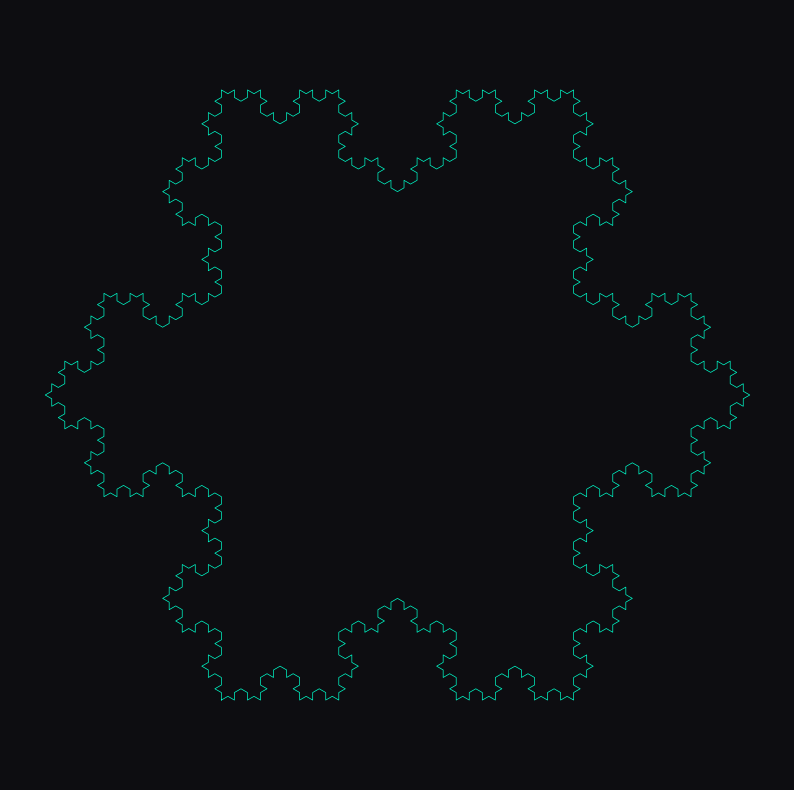
ENGINE L_SYSTEM
AXIOM F--F--F
RULE F -> F+F--F+F
ANGLE 60
ITER 4
RENDER
Mandelbrot Set
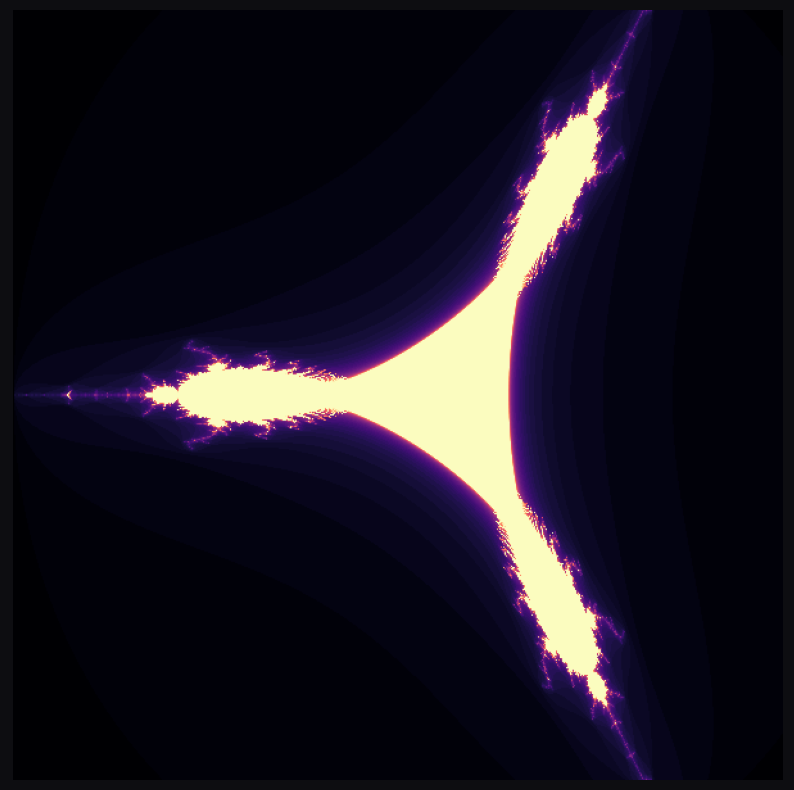
ENGINE PIXEL
FORMULA np.conj(z)**2 + c
X_RANGE -2.0 1.5
Y_RANGE -1.5 1.5
RES 600
ITER 60
COLORMAP magma
RENDER
Fern

ENGINE IFS
ITER 80000
# Regole: prob, a, b, c, d, e, f
RULE 0.01   0.0   0.0   0.0   0.16  0.0  0.0
RULE 0.85   0.85  0.04 -0.04  0.85  0.0  1.6
RULE 0.07   0.2  -0.26  0.23  0.22  0.0  1.6
RULE 0.07  -0.15  0.28  0.26  0.24  0.0  0.44
RENDER